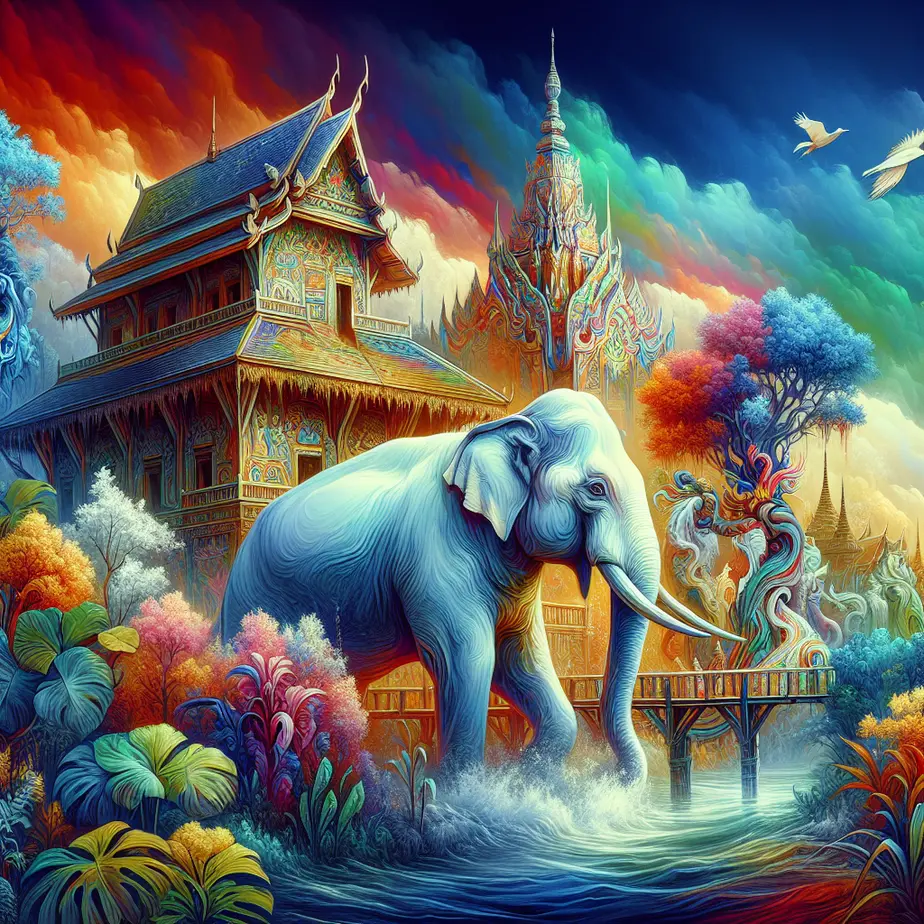
The white elephant has captivated the imaginations of cultures across Southeast Asia for centuries. With its ethereal presence and deep-rooted symbolism, it stands as a testament to the region’s rich tapestry of spiritual beliefs and historical narratives. Our journey through the evolution of the white elephant takes us from the divine courts of ancient Siam to its place in modern idiomatic language.
The Birth of a Living God
In Buddhist mythology, the white elephant holds a revered position. Its legend begins with Queen Maya, the mother of the Buddha, who dreamt of a white elephant before his birth. This sacred animal’s image became synonymous with purity, prosperity, and spiritual awakening.
This reverence is rooted in biology. Elephants with leucism are exceptionally rare, their pale skin seen as a divine anomaly. Ancient Siamese and Burmese kingdoms interpreted the discovery of such an elephant as a celestial sign, embodying their rightful rule and ensuring agricultural prosperity.
The white elephant, thus, became a cosmic anchor, believed to secure the welfare of the people and the legitimacy of rulers. It was a spiritual link between the heavens and earth, rich in symbolism and cultural significance.
The Burden of Divine Ownership
Owning a white elephant was both a privilege and a burden. These majestic creatures lived in opulence, housed in palaces with diets that included sandalwood and gold-flecked fruits. Their upkeep was astronomical, reflecting their exalted status.
Strict laws in Siam and Burma forbade using these elephants for labor. They were physically idle but spiritually indispensable, embodying the state’s honor and cosmic fortune. Wars were fought for their capture, as kings eyed these living talismans to enhance their prestige.
The Weaponization of Generosity
Over time, the white elephant transformed from a sacred symbol to a crafty weapon in political play. Cunning monarchs wielded these animals as tools for financial ruin. The gift of a white elephant became a sinister blessing, one that courtiers dreaded receiving.
- The gift was irreversible, binding the recipient to exorbitant upkeep.
- Selling or neglecting the elephant equaled treason, defying the king’s gesture and divine will.
This chess-like strategy of gifting aimed to bankrupt rivals, leveraging divine ownership as an inescapable trap.
The Victorian Translation
When British colonialists encountered this complex tradition, they interpreted it through a lens of Western pragmatism. To them, the concept of maintaining such a costly, non-functional creature was baffling. This interpretation led to the term ‘white elephant’ entering the English lexicon as a symbol of extravagance without utility.
This linguistic shift reflected the era’s fascination with efficiency, a product of the Industrial Revolution that valued utility over ritualistic reverence.
Modern Monuments to Vanity
Today, the term ‘white elephant’ resonates in modern contexts. Abandoned Olympic stadiums, grand but unused infrastructures echo the ancient pitfalls of unsustainable grandeur. These modern relics stand as echoes of past pursuits of prestige.
The white elephant’s journey from celestial icon to modern metaphor challenges us to reflect on the sustainability of our ambitions. Are we still ensnared by the allure of aesthetic splendor at the expense of practicality?
As you navigate life’s choices, consider the ‘white elephants’ in your path. Where does prestige overshadow utility?
Conclusion
The white elephant is more than a cultural and linguistic curiosity. It symbolizes a profound narrative of spiritual awe, political strategy, and modern reflection. From the divine courts of Siam to its place in our words and world projects, the sacred white elephant invites us to ponder our values and the cost of our pursuits. Remember, in the dance between prestige and practicality, the lessons of the past echo profoundly into our present.