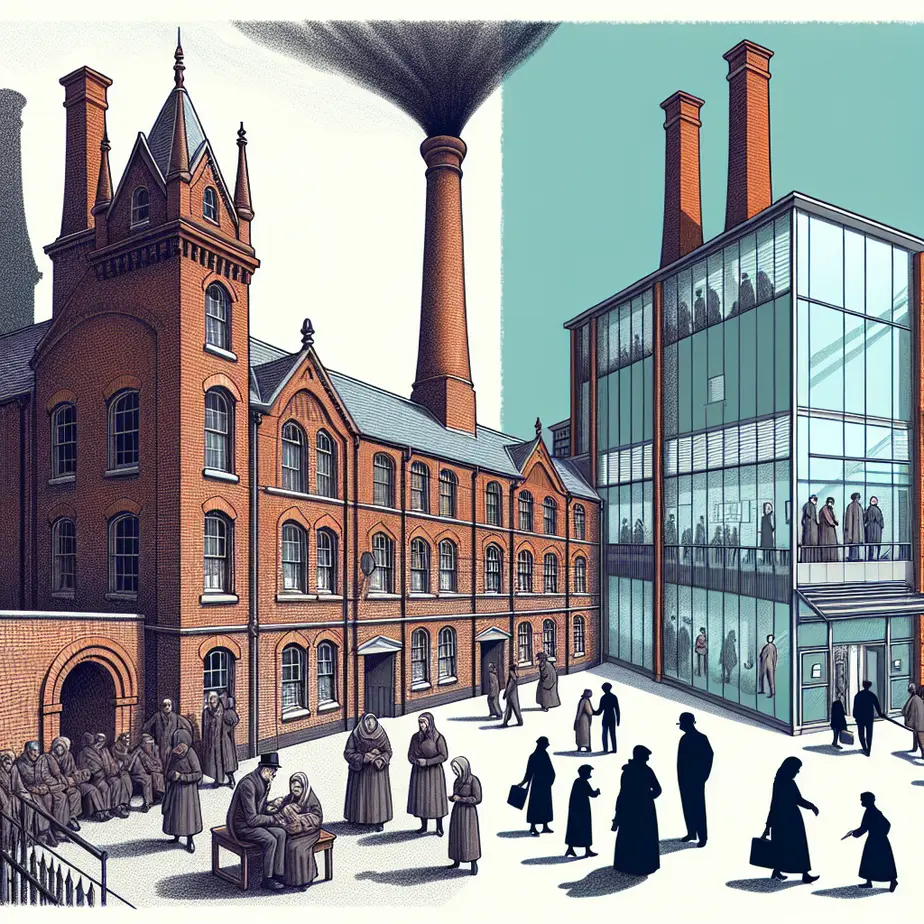
The Victorian workhouses have long been a haunting chapter in British history, a symbol of the harsh, punitive approaches once used to address poverty. Originally established following the 1834 Poor Law Amendment Act, these institutions were created under the guise of providing refuge for the destitute. However, the shelters quickly devolved into oppressive places synonymous with suffering, as they enforced a regime of forced labor and austere living conditions. Despite their intended purpose, workhouses became feared establishments, emblematic of the shame and degradation imposed upon those who sought help.
The Architecture of Shame
Workhouses were deliberately constructed with an intimidating presence that served as a social deterrent. Far from offering a haven for the poor, these grim stone edifices were intentionally built to be more menacing than prisons. They stood as imposing reminders of the state’s control, looming over entire communities as material embodiments of institutionalized shame.
The architecture of the workhouses was modeled to enforce discipline and surveillance, with layouts often resembling Jeremy Bentham’s panopticon concept. This architecture facilitated constant monitoring and control, stripping away any semblance of privacy or individuality among the inmates. The physical separation of families upon entry further hampered any attempts to form bonds or resist the overwhelming dominance of the shadowy institution.
A Legacy of Punishment
Central to the philosophy of the Victorian workhouses was the principle of ‘Less Eligibility,’ which stipulated that conditions within these walls should remain harsher than the lowest-paid work outside. Under this mandate, individuals endured daily drudgeries, from bone-crushing labor to oakum-picking, tasks degrading enough to dissuade others from seeking aid, no matter their desperation.
The rules of the workhouse were clear: those seeking support would face dehumanization. Heads were shaved, individuality stripped, and uniforms imposed as a visual representation of submission to the state. In this way, the systemic brutality of Victorian robustures turned poverty relief into a method of control and moral judgement.
The Path to Modern Welfare
In the early 20th century, British society began shifting away from this punitive outlook toward more compassionate welfare models. Influenced by the compelling poverty data in the Booth and Rowntree reports, it became apparent that poverty often arose from systemic failures rather than personal shortcomings. The Liberal Reforms of the early 1900s marked a significant pivot, introducing measures that allowed for the concept of social support through broader societal lenses.
The development of the welfare state sought to abolish the relics of the workhouse era. The vision of a ‘Cradle to Grave’ system, pioneered in 1948, was a revolutionary step toward offering a more humane and equitable social safety net. However, despite the outward progress, echoes of the workhouse’s ethos can still be felt in modern welfare discourses.
The Shadows Persist
Even in our modern age, the narrative distinguishing between the ‘deserving’ and ‘undeserving’ poor persists stubbornly within welfare systems. This is evident in terms such as ‘strivers versus skivers,’ which continue to reflect the Victorian classification of poverty-worthiness. Current measures such as stringent benefit sanctions and austerity-induced cuts suggest a continuance of workhouse-era ideologies, prioritizing fiscal prudence over individual dignity.
Additionally, the digital age is seeing a new form of surveillance akin to the once all-seeing eye of the workhouse. The gig economy, with its stringent algorithms, and punitive sanctions bear similarities to past practices of systematic oversight and control.
A Call for Change
To truly overcome the lingering shadows of the Victorian workhouse, reassessing our perspectives on poverty and welfare is essential. Initiatives such as Universal Basic Income represent a move towards dismantling these archaic barriers, yet historical prejudices linger within these discussions. To forge a fairer future, we must recognize and move beyond these traumas towards policies that embrace radical empathy and human dignity.
Throughout history, too often, poverty has been viewed through a moral lens. Today offers an opportunity to challenge this notion and build a more inclusive society, one where welfare is a right, not a punishment. Acknowledging the past is paramount to breaking free from it, empowering us to redefine social contracts in ways that celebrate compassion over judgement.
In reaching this new vision, let us not forget the lessons left by these formidable structures. As we unmask the welfare legacy of the Victorian workhouses, our challenge is to ensure that the future prioritizes compassion, humanity, and true understanding above the scorched injustices of our shared architectural past.